For Customers
How we work with you
Three ways to collaborate — transparent pricing, honest timelines, IP fully yours.
Cooperation models
Pick the model that fits your project. Hybrids are possible — let's talk.
Hourly billing
See “How our rate is set” below
Invoiced monthly (at most every 3 months) based on hours actually worked. Either side can end the cooperation at any time.
Best when the project is not yet fully defined (likelihood of hitting the target below ~70%), or when the timeline depends on more than us. Think of it as an extension of your own internal R&D — continuous progress reports, shared interim results. IP fully yours.
- ✓ Maximum flexibility
- ✓ Full visibility
- ✓ Best for exploratory or evolving work
Fixed price
For a clearly defined scope
Price agreed upfront. Paid once or in milestones, depending on project type and timeline. The contract clearly defines timeline, requirements, financial support, and penalties.
Best when the likelihood of meeting your requirements is above ~70%. IP fully yours.
- ✓ Predictable budget
- ✓ Clear deliverables
- ✓ Best for well-scoped projects
Exclusive partnership
In exchange for equity in your company
A reduced rate (roughly −50%) in exchange for an agreed equity stake in your company — we become co-owners. Suited to start-ups and spin-offs. Aligned for the long run: the stake may later be sold, and we share in the profit — both only on success.
IP is shared (through co-ownership).
- ○ Lowest ongoing cost
- ○ Deep long-term alignment
- ○ Shared risk & upside
Who owns the work (IP)
The intellectual property is the customer's — you can patent it freely. If a competitor of yours later approaches us, the customer who worked with us first is informed and decides whether we may also work with that competitor. That protects you, and keeps things fair for everyone.
Exclusive partnership: IP is shared, because ownership is shared.
How our rate is set
We show the maths. You see exactly what the numbers are built on.
Our rate starts from the true cost of one engineer, not a number we picked:
| Slovenian average gross salary (stat.si) | €2,677 / month |
| We pay +40% above average | €3,750 / month |
| + employer contributions ("bruto 2", +16.1%) | ≈ €4,353 / month |
| + holiday allowance (regres) €2,100/yr + winter allowance €800/yr | — |
| = true annual cost of one engineer | ≈ €55,000 / year |
| Effective days: 251 SI working days − 26 vacation − 30 other absences | 195 days/yr |
| Effective hours: 8 h − 0.5 h lunch − 1.5 h non-effective | 6 h/day |
| = effective working hours | ≈ 1,170 h / year |
| Pure internal cost = €55,000 ÷ 1,170 h | ≈ €47 / hour |
On top of that cost we set the customer rate:
- ≈ €50/h — near cost — for long-term projects (a steady commitment).
- ≈ €100/h — for short-term / advisory work: brainstorming, an outside expert view on your R&D, an opinion from our experts so you can carry the project on yourself.
- In between — scales with project complexity and the seniority/type of staff on the tasks.
Source: internal cost model.
Where your money goes
Transparency isn't just open books — it's showing how every euro is used.
The remainder (profit) is reinvested — winning new work, the unexpected, shared with employees, spin-offs, or the exclusive-partnership model — decided every year by all employees.
So ~80% of what you pay goes straight into your project — about 90% of what it would cost you to build the same capability in-house, but without hiring, onboarding and later laying people off. You get experts only for as long as you need them: cheaper and faster access to development.
Reference projects
Projects completed by our team members before the company was founded — across mechanical, electronics, and software.
EV battery pack
High-performance EV battery pack — 864 lithium-ion cells (SONY VTC5 18650) arranged 8p108s for 8 kWh at 450 V DC, delivering 80 kW peak and 30 kW continuous. CFD-driven forced-air cooling kept cells under 60 °C at 40 °C ambient, validated against measurements on the running pack. Mechanical design, thermal management, BMS hardware, and BMS firmware — our first collaboration as a team, seven years before the company existed.
Wafer-and-stencil-mask aligner
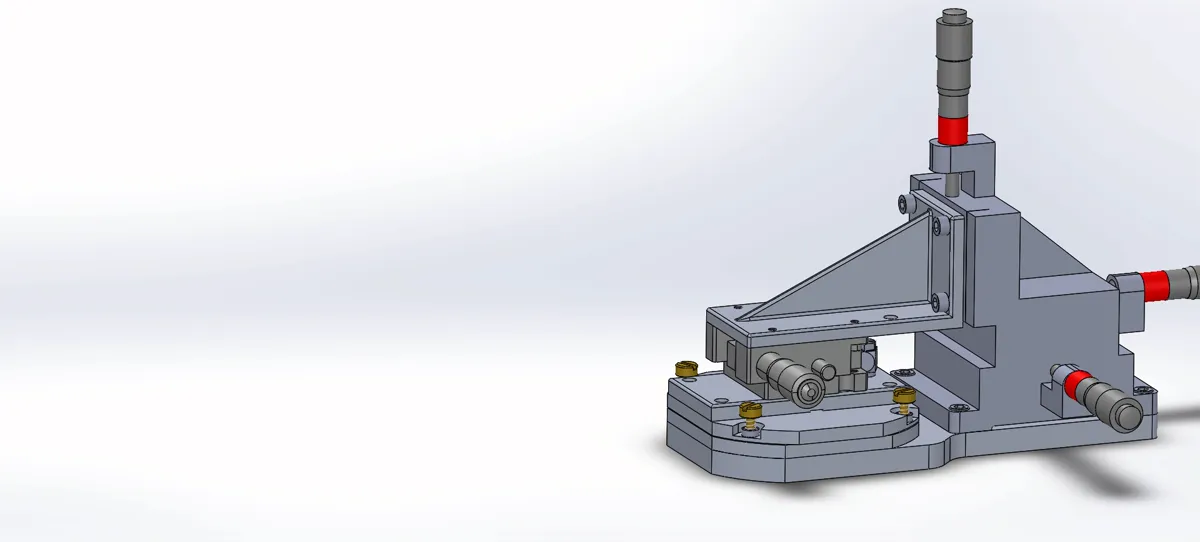
Precision aligner for the IOM-CNR materials-science research institute (Basovizza, Trieste). Aligns a 2-inch GaAs wafer with a 4-inch silicon stencil mask under an inverted microscope across four axes (X, Y, Z, rotation), then transfers the aligned stack into a vacuum evaporator without losing alignment. Three independent vacuum circuits clamp wafer, mask, and mask-holder separately. Built end-to-end — specification, CAD, magnetic-force and vacuum-flow calculations, BOM, drawings, and delivered hardware — over three months in late 2021.
Self-balancing Segway
Two-wheeled self-balancing vehicle, designed, fabricated, wired, and programmed end-to-end in six months. Aluminium chassis modelled in Autodesk Inventor, then waterjet-cut, CNC-bent, and TIG-welded. Twin 24 V / 250 W DC motors drive 17″ moped rims; an Arduino Mega reads a 6-axis IMU at 100 Hz and drives the wheels through two H-bridges, holding the rider upright on a tunable PID loop. The founder’s first project across the full stack we now offer clients.
Electric motor & power electronics
40 kW electric motor combined with custom power electronics. Full motor controller design including gate drivers, current sensing, and field-oriented control firmware.
Open finances
We publish our financial data openly — revenue, costs, and margins — because we believe transparency is the foundation of trust. Companies are required to report to the government every year anyway. We see no reason to hide this from our customers and employees as well.
Names of employees and customers are anonymised with fictitious identifiers to protect individual privacy. Everything else is open.
Ready to start?
Describe your project. We'll tell you honestly whether we can help and at what cost.
Janko Kobal
MSc in Electrical Engineering